- Jul 14
Can Real Estate Agents Use AI to Write SEO Content?
- Matt McGee
- Real Estate SEO & AI SEO
Yes, a real estate agent can use AI to write SEO content for your real estate business. But there's a condition: What you publish has to include valuable expertise and experiences that could only come from you, and show effort and originality that go beyond copying an AI answer word-for-word.
Google's been very clear in recent years: The quality of what you create and publish is more important than how you make it. But what's unsaid -- and I'll show you what this looks like below -- is that AI alone isn't good enough to create the quality that Google (and AI sites, ironically) wants to reward.
I've worked exclusively with real estate agents, teams, and brokerages on real estate SEO since 2017. I run a private SEO/AI SEO mastermind for real estate agents, and I write about this stuff every week in my newsletter, Marketing Unlocked. So when I tell you AI content can work or that it can wreck your rankings, it's because I've seen both happen with real agents and real websites. Let's unpack how to make sure your experience is the former, not the latter -- i.e., working, not wrecking.
What Google Says About Thin AI Content
There are two Google frameworks that should guide how you create content and how you use AI: E-O-V and E-E-A-T. They both come from from Google's Search Quality Raters Guidelines, a nearly 200-page document that Google gives to people who grade its search results. (They're called Search Quality Raters.)
E-O-V stands for effort, originality, and value. Google describes the lowest quality content on the web as pages that show "little to no effort, little to no originality, and little to no value." Last I looked, that phrase appears 19 times in the guidelines doc. (19 times!!) Flip that statement around, and you get the standard your content needs to clear: effort, originality, and value.
Think of it this way: If a piece of content doesn't require your effort, doesn't say anything original, and doesn't help the reader in a way that's specific to you, it's low quality and Google can spot that. (So can your readers.)
The second framework is E-E-A-T: experience, expertise, authoritativeness, and trustworthiness. It's not a ranking factor, it's the kind of content Google wants to show searchers. It's what Google tells its human quality raters to look for when they judge the quality of search results.
Put the two frameworks together, and you get a clear standard: content built with effort, originality, and value, backed by your own experience and expertise.
How to Make AI Content Pass the "I Made This" Test
I think there are five things you have to do with your AI-written content to turn it something that looks and reads like you made it. And yes, this requires some effort...which you already know is a must.
1. Write in first person
When I'm working with clients or my wife on blog content, the more "I" and "we," the better. I want to include things like
"When I helped a family find their first home in this neighborhood last year..."
"My husband and I have talked about downsizing, too." (we have a sentence just like that in one of Cari's blog articles on downsizing)
"We staged this home and had three showings within 24 hours."
First person signals a real human wrote this. It's a great way to separate your content from a wall of AI-generated text.
2. Tell real stories from your own transactions
This is a natural extension of writing in first-person. Every neighborhood, every price range, and every type of buyer or seller you've worked with gives you material. Did a deal almost fall apart over an inspection issue? Did a first-time buyer get outbid three times before finally winning a house? Tell that story. AI can't invent it for you -- it's what makes your content impossible to copy.
3. Insert local, specific detail AI can't generate
AI knows general facts about your city. It doesn't know which coffee shop the new construction near Elm Street replaced, or why one block of your neighborhood sells faster than the block next to it. Those details come from living and working there. Put them in all your content.
4. Use original or hard-to-find data
Some articles are begging for great data to support what you're saying. If you can come up with original data that an AI would never know, that screams "I made this." It could be something as simple as comparing days on market for homes in one price range vs. days on market in another price range.
5. Let your opinion show, not just facts
AI tends to write balanced, neutral summaries. That's the opposite of what builds trust. Tell readers what you think. Is a certain suburb overpriced right now? Say so. Do you think buyers are making a mistake waiting for rates to drop? Say that, too. Opinions, backed by your experience, are what make people remember you.
A Simple Process: Where AI Fits at Each Step
AI has a place in the real estate content and blogging process. It's just not the place most agents put it. Here's how I recommend you use it, step by step.
1. Generating content/article ideas. AI is useful here. Ask it to help you brainstorm questions your buyers and sellers search for.
2. Keyword research. AI is not good at this. Use a real keyword research tool, instead.
3. Making an outline. AI is useful here. Let it help you structure the article and identify related topics to cover. (Bonus tip: Ask a different AI to review and improve the first outline, but make sure you get final say in what the outline includes.)
4. Gathering your stories and expertise. No AI here. This is where I interview my wife or client. I want their exact words and details before I write a single sentence of the draft.
5. First draft. AI can help you get words on the page faster. But treat this draft as a skeleton, not a finished product. Steps 6 and 7 will help you do that.
6. Rewriting in your voice. This is all you. Go through the AI draft and replace generic statements with your first-person stories, your opinions, and your local details from step 4.
7. Editing and fact-checking. Also you. Make sure every claim about your market is accurate and every story is told the way it actually happened. Keep an eye out for fair housing concerns, too.
8. Publishing. This is you, unless you have something hooked up to your website platform that lets AI do the publishing.
In my process above, AI provides a foundation. It shows up in ideation and rough drafting, but disappears once you get to the last couple steps -- the ones that really separate a generic blog post or page from a great blog post or page. Those are the parts that require real experience.
What Happens If You Overuse AI
If you let AI write your content and publish it word-for-word, it'll probably work...for a while. Maybe it'll work forever.
But we have a phrase in SEO: Everything works until it doesn't. Here's a visual that shows that phrase in action. These are examples of websites that published 100% AI content.
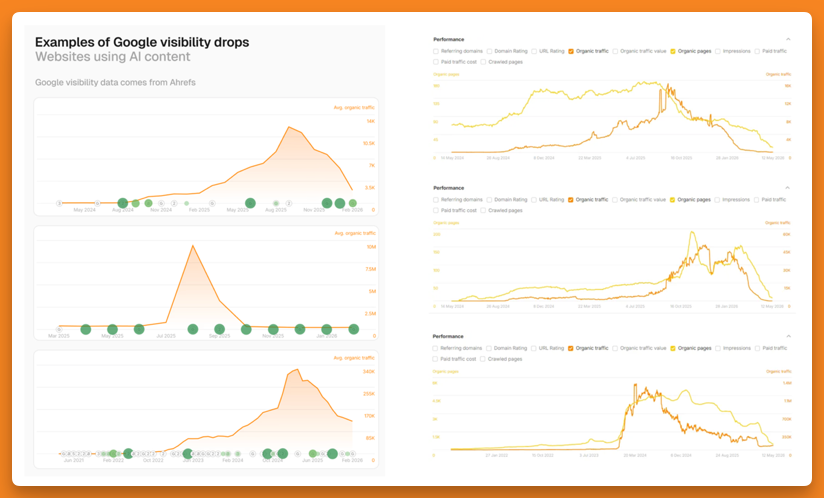
That's "everything works until it doesn't" in action. We call that "Mount AI," because each one looks like a mountain. I'm not saying it's guaranteed this will happen to you if you let AI do too much. But I'm also not saying it won't.
What Happens When You Use AI Just Right
I like this kind of chart, instead:
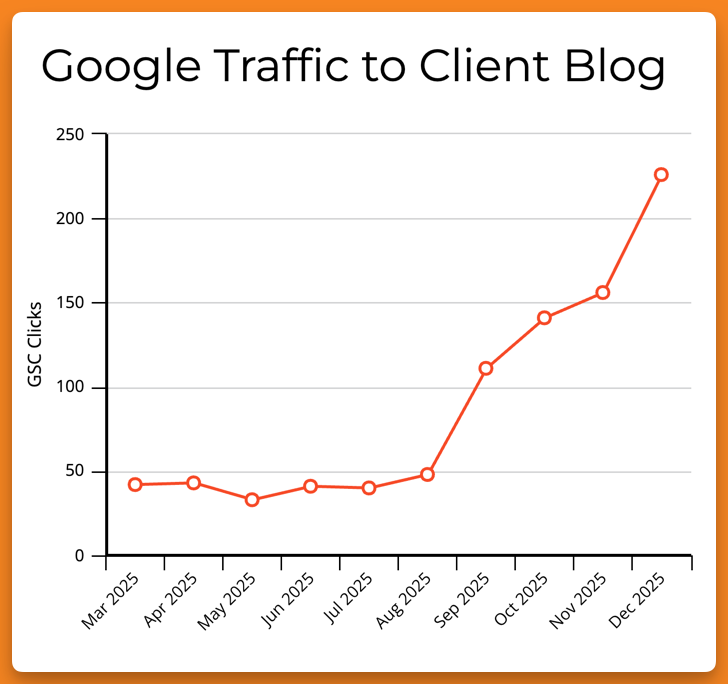
That's a client I worked with in 2025. The first couple months were spent cleaning up old blog content. Then we started doing four new articles per month on her blog. I used AI to help generate outlines and first drafts, but before each article was published, I'd interview my client to get her expertise and experiences so I could put them on the page.
By the end of the year, blog traffic was up 256%. So I think you can say this approach to using AI wisely, not exclusively, worked.
Final Thoughts: The Logo Test
Here's a test I give agents in my mastermind group:
Take the article you just published. Imagine swapping out your logo for another agent's logo and dropping it on their site instead. If it reads the same, no changes needed, you've got a problem. It's too generic. Your name, your story, and your local knowledge should be baked into the content so deeply that it can't be reused by anyone else.
Google's systems, and its human quality raters, are looking for content that shows effort, originality, and value. Skip that step, and you're publishing the kind of content E-O-V was built to filter out.
So yes, use AI in your content process. Just don't let it write the parts only you can write. All of your content should reflect your experiences and expertise -- even especially when you're using AI.
Frequently Asked Questions
Is AI content against Google's guidelines?
No. For years, Google has said publicly that it doesn't penalize content for being created with AI. What it penalizes is low-quality content, regardless of how it was made. The problem isn't the tool -- it's using the tool to publish something generic, inaccurate, or thin on effort, originality, and value.
Will readers be able to tell if I used AI to write a blog post?
I think so. Everyone's "AI radar" is on high alert right now. I think they can tell when content feels generic, even if they're not 100% sure it's AI. Readers notice when a post could have been written about any city, by any agent. And they sure as heck notice when an article is so generic that it's not helpful.
How much of the writing process should be AI vs. me?
Use AI for the parts that don't require your personal experience: brainstorming topics, building an outline, or drafting a rough structure. Everything that reflects your expertise, your stories, and your opinions should come from you. If you're not sure where the line is, ask yourself whether AI could have written that sentence about any agent in any city. If yes, rewrite it.
(Note: "Mount AI" charts via Peec AI, Lily Ray.)
If you liked this article, you'll love my newsletter. Marketing Unlocked arrives in your inbox every other Sunday at 6:00 a.m. ET. You can unsubscribe anytime, but 500+ of your industry peers are reading it and raving about it. Click here to learn why and subscribe.