- Sep 4, 2024
SEO: Do I Need to Optimize for Misspellings?
- Matt McGee
- Real Estate SEO & AI SEO
Let me start with the answer: You probably don't have to optimize your site for misspellings.
But there are some cases where it might be smart, as I'll explain below.
First, here's why you probably don't need to: In most cases, when someone misspells a word or three in their search, Google will automatically fix it and show search results for the correctly spelled version, like this:
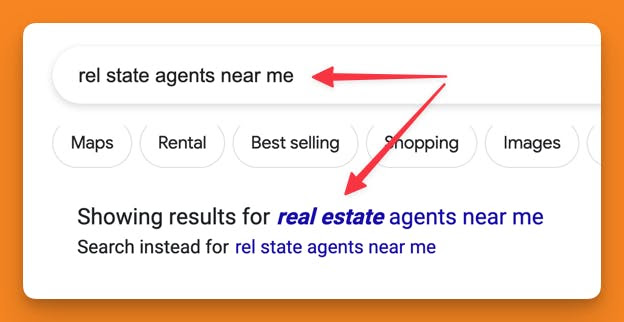
As you can see, Google automatically corrected "rel state" to "real estate."
We deal with misspellings a lot around here. My wife's first name is often misspelled as Carrie (it's actually Cari). Google doesn't even show that spellcheck alert if you search "carrie mcgee realtor" -- it just shows results for the correct spelling.
Now, the reason I said "probably" in the first sentence above is that
for some common misspellings, Google's search results might be different depending on the spelling (Search "helpdesk tips" vs. "help desk tips," for example. You should see different results.)
in some cases, a misspelling might be more commonly used by locals
In cases like those, you might think about optimizing for multiple spellings of the same word or phrase. Let me show you how I used to do this with a non-real estate client.
So how do I optimize for misspellings without looking like I don't know how to spell?
Many years ago, when I was consulting with a dermatologist, we had to optimize for misspellings. People often misspelled the names of skin conditions and diseases (eczema, psoriasis, rosacea, etc.) and Google wasn't as sophisticated as it is now about auto-correcting for the right spelling when someone searched.
So what we'd do is use the correct spelling, but then intentionally call out/reference the misspellings, too. I don't remember what the exact misspellings were, but it might've looked like this:
"...common symptoms of eczema (or "eggzema" as it's often misspelled)..."
"Eczema is a condition that causes dry, itchy skin. (You might have seen it spelled "eggzema," but the correct spelling is "eczema.")"
You can see in both examples that I'm getting the misspelling on the page, but in such a way that I'm telling the reader I know it's a misspelling. We did that in the page copy, but if the misspelling is common enough, you could use it in your title tags, H1s/H2s, etc.
Like I said above, I don't think you need to do this much these days. But if you have a town name or something that locals affectionately spell wrong, and people actually search using the misspelled version, you can do something similar: "5 Things to Know About Living in Kennewick (or 'Kenwick' as Locals Call It)".