- Nov 2, 2024
5 SEO Tactics with High Return-on-Time-Investment
- Matt McGee
- Real Estate SEO & AI SEO
In real estate and SEO, we often talk about ROI -- return on investment. If you're going to spend your money on marketing, sales, or a new tech tool, you're looking to earn back more than you spend.
There's another concept we don't talk about as much: your investment of time. Whether you have a marketing person to help or if you're doing your own marketing, it's important to find tactics that offer a good return for the time you spend on it.
With that in mind, here are five real estate SEO tactics that offer a high return-on-time-investment...aka, ROTI.
1. Internal linking
I originally had this lower on the list, but had to move it up top. This is such a missed opportunity and one of the most underrated SEO tactics. Getting links from other sites can be tough for any small business, but you can make up for that to some degree by acing your internal links. In practice, there are a couple of quick and easy places to get SEO wins here:
Optimize your main site navigation. If you have a link in your navigation that says "home search" and leads to your IDX content, change the anchor text to "LOCATION homes for sale." That's a keyword people use.
Optimize your in-content links. When you're writing content on your site -- whether it's pillar pages or blog posts -- always look for opportunities to link to other pages on your site, preferably with a keyword in your anchor text.
Here's what #2 looks like in practice:
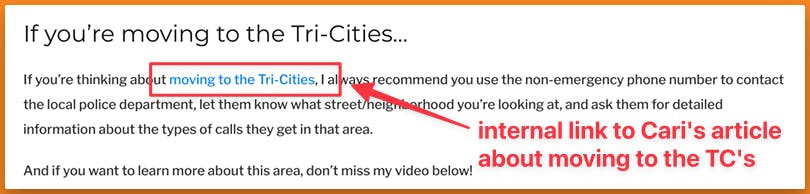
That's from a blog post my wife did after our hometown was named one of the safest places to live in Washington state. We have this section where we're talking to people who might be thinking about moving to the Tri-Cities, so when we use that exact keyword, we turn it into a link that points to her "Moving to Tri-Cities, WA? Here's 7 Things to Know" blog post.
I'm pretty sure that we have some content ranking highly solely on the strength of internal links. Always look for opportunities to do this in your content. The ROTI can be terrific!
2. Studying Google's search results
Whether I'm working on something for a client or my wife, I spend a lot of time doing searches and analyzing the content on Google's page one. The main things I'm looking for when I do this are
who's already ranking and how strong is their article/page/domain
how much time would it take to craft an article/page that can compete
This is really about finding low-hanging fruit. If I have a list of 5-10 blog posts we want to publish to attract sellers to the website, which ones have the least competition? Which ones should we write first?
If studying Google's search results like this is new to you, it may not be a fast process at first. But you'll get the hang of it after a while. I can usually tell pretty quickly what the opportunity is when I'm looking at current search results.
3. Understanding searcher intent
This is similar to the above, but instead of studying Google's rankings, you're studying what the buyer or seller really wants to know when they search.
I use this keyword example a lot: is LOCATION a good place to retire?
If you're going to write a blog post or make a video in an attempt to answer that question and get buyer leads from people who want to retire in your area, you have to understand the intent behind the search. A pretty quick way to do that is to take the next step from what I suggested above: Do that search on Google, and then go look at the high-ranking content.
For that question, the buyer/retiree probably wants to know things like: Is the area safe? Does it have good medical facilities? What's the cost of living? Does it have senior housing communities? Does it have things to keep seniors busy -- parks or lakes or whatever? When you understand the searcher's intent, making great content is so much easier.
You could also come up with a ChatGPT prompt to help understand the intent behind specific keywords and questions that buyers and sellers Google. This is a high ROTI activity because it helps you quickly understand what your article or video needs to address.
4. Optimizing your Google Business Profile
I keep seeing agents asking on Facebook who they should hire to fix up their GBP. Even though that's something I help clients with, I always reply: It doesn't take long, you can do this yourself.
Claiming and/or optimizing your GBP is like the ultimate low-hanging fruit in local SEO. It gives you the chance to rank in the local/map results for those real estate agent LOCATION-type keywords.
Not sure how to optimize your GBP? My in-depth guide shows you the exact sections of your GBP that directly impact your rankings in local search results. Get my Google Business Profile guide for real estate today.
5. Optimizing your title tags
Title tags are the #1 on-page signal telling Google what a page is about. When I'm doing a hands-on webinar or workshop with agents, I always tell them: If you do only one thing today to improve your SEO, optimize your title tags.
There are so many agent websites that have "Home - Sally Jones" as the title tag on the home page, or "Welcome - Johnny Smith." You're not even giving yourself a chance to be relevant to Google with a title tag like that.
Optimizing title tags across your site won't suddenly make you rank #1, but it will open the door to future success. And for most of your pillar pages, it shouldn't take a huge investment of time, either.
(As I teach in the real estate SEO course, your home page title tag should typically include your name, the primary location(s) where you work, and either "Realtor®" or "real estate agent.")
Final Thoughts
We talk a lot about the ROI of marketing tactics, which we should do when a financial investment is involved. But your time is also valuable, so it makes sense to also talk about tactics that offer a good bang for the buck without taking up a ton of time. The five tactics above are great examples of real estate SEO tactics with a high ROTI...return on time investment.
If you liked this article, you'll love my weekly newsletter. Marketing Unlocked is free and arrives in your inbox every Sunday morning. You can unsubscribe anytime, but 600+ of your industry peers are reading it and raving about it. Click here to learn why and subscribe.